

AcademyCourses
Three courses, six lessons each.
The lessons of all three courses come in the free first month without a certificate, and in the certificate plans with their certificates. Lessons open when the content committee approves their content; the titles here are drafts.
Course 1 of 3
Professional conduct and business ethics
- For whom
- For anyone starting work in finance or getting ready for it, and anyone who wants to know what to do when asked to do what is not permissible.
- Not for
- It is no substitute for an employer’s code of conduct or the law of their country.
- The exam
- Situations that change from paper to paper, and every wrong option is a named error. One submission, with the right to an explanation and to appeal.
The six lessons
- Integrityno misleading figure under your name
- Objectivity and conflicts of interestseparate your interest from your judgement
- Competence and due caredo not take on alone what you cannot do well
- Confidentialitywhat you learned through your work is not yours
- Professional conductyour deadlines, your authority and your colleagues
- When you are asked to do what is not permissiblethe escalation ladder
Course 2 of 3
Financial modelling
- For whom
- For anyone who builds a financial model for planning, funding or a feasibility study.
- Not for
- It does not suit someone who has not yet mastered entries and statements, because a model is statements built from assumptions.
- The exam
- Situations that change from paper to paper, and every wrong option is a named error. One submission, with the right to an explanation and to appeal.
The applied part (The model you build) is not yet wired to its measure. Next
The six lessons
- Linking the three statementsa model whose statements do not connect is just three tables
- Working capital in daysreceivables, inventory and payables in the language of time
- Depreciationhow an asset’s cost is spread over the years it serves
- The instalmentloan principal and the price of money in a single amount
- Assumptions with their sourcesand scenarios and sensitivity
- Reading the cash flowsprofit is an opinion, cash is a fact
Course 3 of 3
Business valuation
- For whom
- For anyone who estimates the value of a business for a partnership, funding or a decision.
- Not for
- It is no substitute for a valuation report required from a licensed party.
- The exam
- Situations that change from paper to paper, and every wrong option is a named error. One submission, with the right to an explanation and to appeal.
The applied part (The two-method valuation) is not yet wired to its measure. Next
The six lessons
- The time value of moneyand figures from different times are not added together
- Free cash flowwhat is left for the providers of finance after the company keeps going
- Capital structureand capital is not free
- Weighted average cost of capitalthe discount rate that all the capital demands
- Terminal valueeverything beyond the forecast years in a single figure
- Valuation by multiplesa comparison, not a calculation
Anatomy of a lesson
Seven fixed parts, in every lesson.
This is the Integrity lesson, the first in the professional conduct course, in its seven parts as drafted.
- 1The idea in one line
Integrity in financial work means no figure leaves your hands that you know misleads its reader, even if every character in it is correct.
- 2Why it matters to you
Because a decision you do not see is built on a financial figure: a loan granted, a salary paid, a tax settled.
- 3The rule
Do not take part in information you know is false or misleading, and do not stay silent about an omission that makes it misleading.
- 4How you recognise it at work
“If the reader knew what I know, would they read this figure the way they will read it now?”
- 5An example from work
Your manager asks you to record a sales invoice due next month in this month’s sales. The invoice is real and the amount is right, but the month is wrong.
- 6The common mistake
“The amount is small, so it doesn’t matter.” Materiality governs what is presented, not what may be falsified.
- 7The mark of mastery
Being able to tell your manager “no”, with the reason and an alternative.
From the platform
The lesson, the curriculum and the exam, as you see them.
Screens from the Academy platform at a readable size; press “Enlarge” to see each one whole. The concepts shown come from the simulation curriculum; the courses use the same structure.
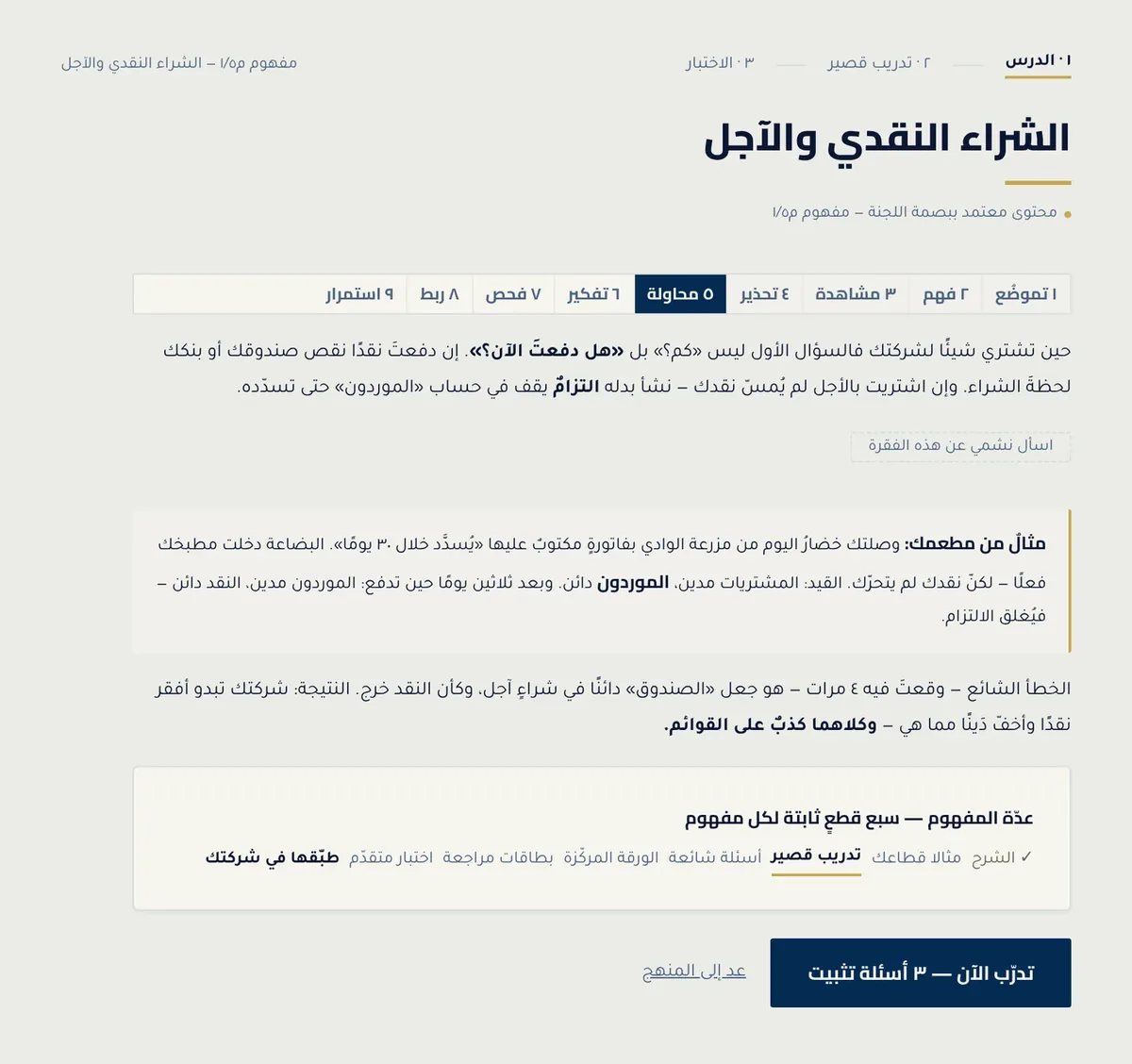
A lesson in steps, with Nashmi beside every paragraph.
- Three steps: the lesson, a short drill, then the test.
- A rhythm of nine beats, from orientation to continuation, with the current beat shown.
- “Ask Nashmi about this paragraph” beside each paragraph, and an example from your sector.
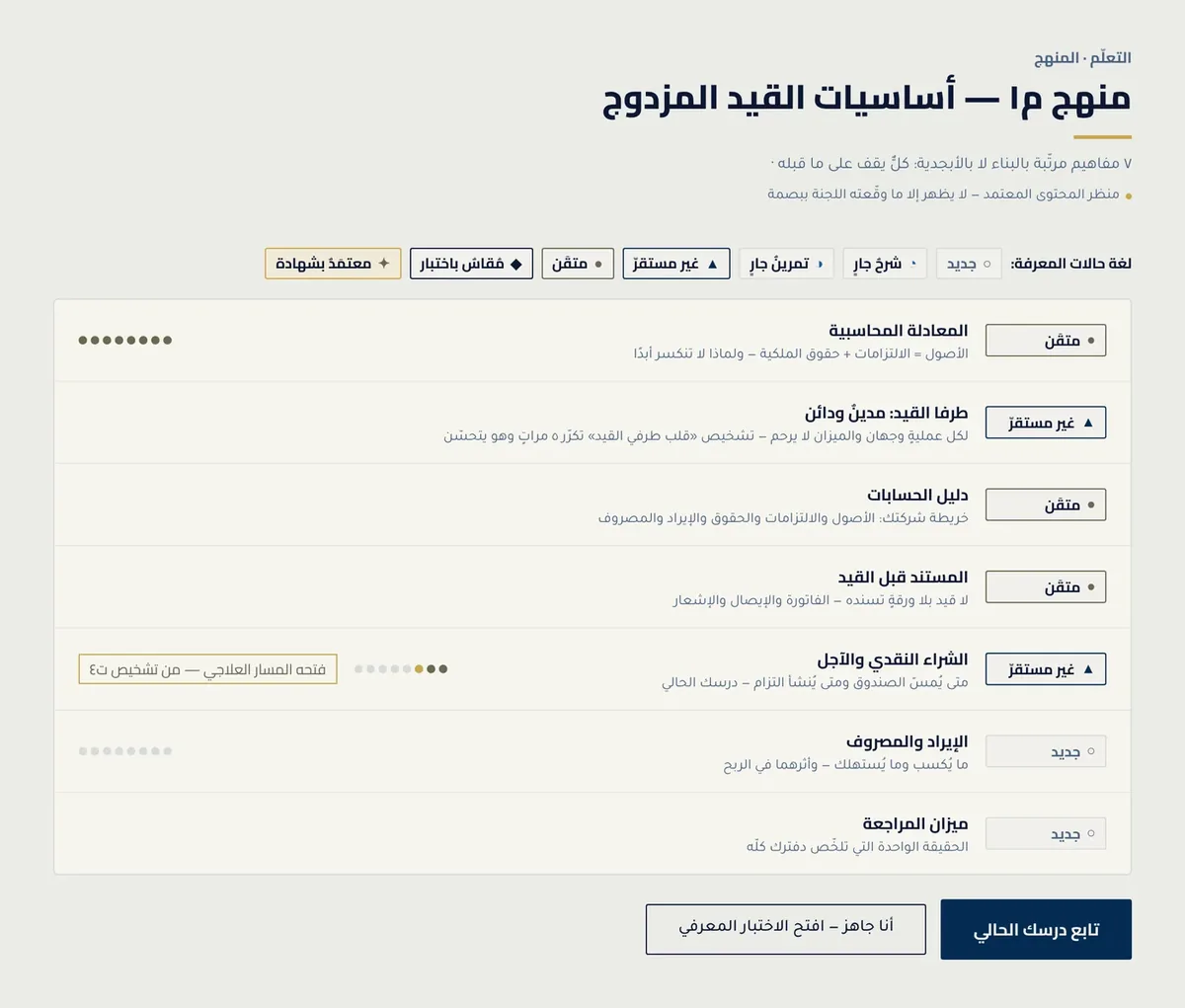
A curriculum ordered by what builds on what, with states the engine writes.
- Each concept stands on the one before it, not in alphabetical order.
- Seven knowledge states, from “new” to “certified”.
- The remedial path opens what you need from the diagnosis of your errors.
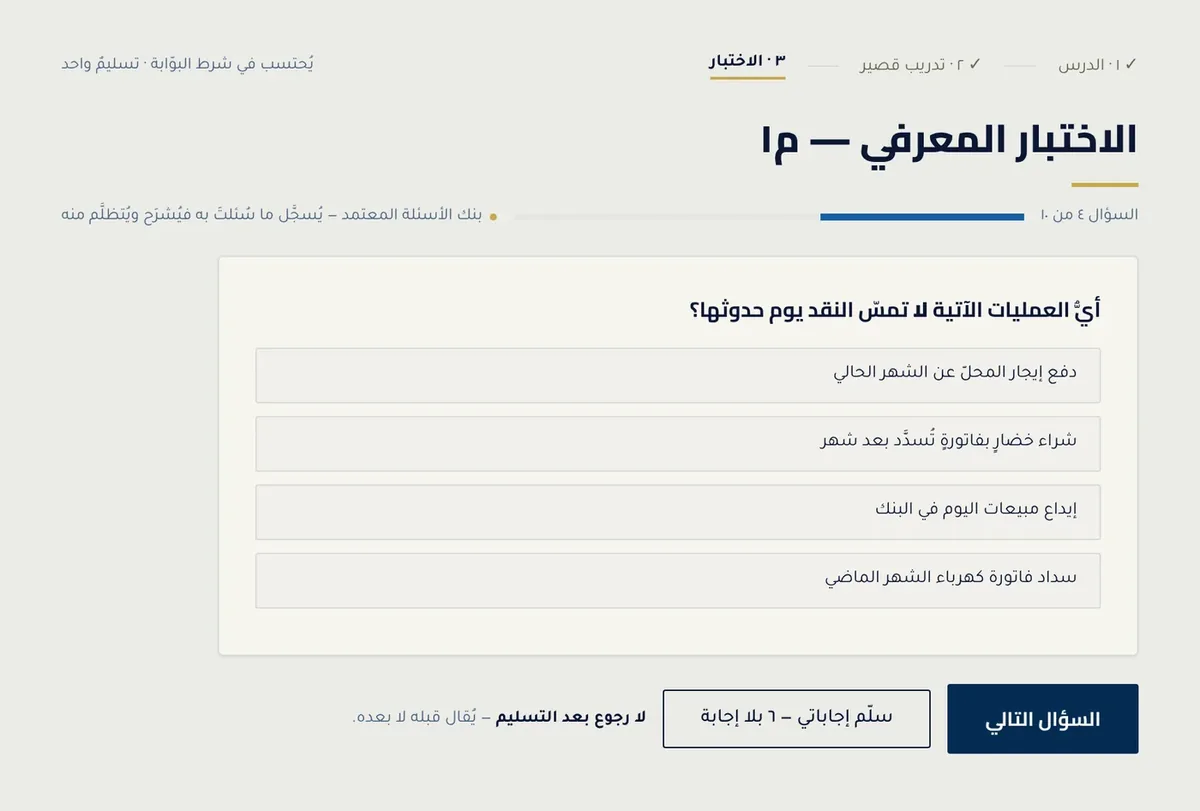
One submission, and every question is logged.
- It counts toward the gate condition, with no going back after submission.
- What you were asked is logged, so it can be explained and appealed.
- Questions come from the approved question bank.
Questions
About the courses.
Are the courses free?
Their lessons are open in the free first month, without a certificate. After it they are in the 200 and 250 plans, with each course certificate.
When do the lessons open?
When the content committee approves their content. The content committee is an automated review that records each lesson’s source. We give no date.
Is a course certificate a professional accreditation?
No. It is a performance certificate from CFO+ that says what was measured: the six lessons and their exam, plus applied work in modelling and valuation.
Which course should I start with?
If you are starting work in finance, begin with professional conduct. Modelling does not suit you before you master entries and statements, which the simulation teaches.
Start
Six lessons each, and the first month is free.
Free for the first month · No card · Lessons open when the content committee approves their content